Wednesday, February 4, 2026

Heavy-duty Vehicle Drive Shaft


Heavy-duty Vehicle Drive Shaft


Heavy-duty Vehicle Drive Shaft


Introduction


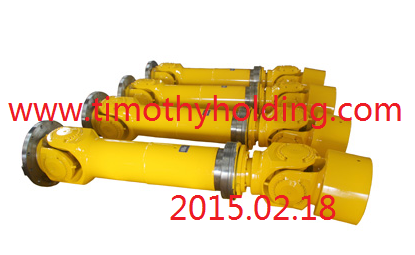
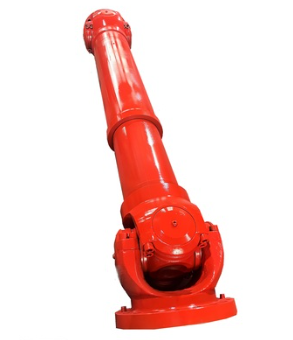
A drive shaft consists of a shaft tube, a telescopic sleeve, and a universal joint.

The Drive Shaft is a circular component that connects or assembles various parts, while being capable of moving or rotating. It is generally made of lightweight alloy steel tubes with excellent torsional resistance. For front-engine, rear-wheel-drive vehicles, it is the shaft that transmits the rotation of the transmission to the final drive. It can consist of multiple sections connected by universal joints. As a high-speed rotating body with minimal support, its dynamic balance is crucial. Typically, drive shafts undergo dynamic balance testing before leaving the factory and are adjusted on a balancing machine.


Function

The drive shaft is a key component for transmitting power in a vehicle's drive train. Its function, together with the gearbox and drive axle, is to transfer power from the engine to the wheels, enabling the vehicle to generate driving force.


Applications

Special vehicle drive shafts are mainly used in models such as oil tankers, refueling trucks, sprinkler trucks, sewage suction trucks, fecal suction trucks, fire trucks, high-pressure cleaning trucks, road wreckers, aerial work platforms, and garbage trucks.


Structure


Universal Joint


The universal joint is a critical component of a vehicle's drive shaft. A vehicle is a moving object. In rear-wheel-drive vehicles, the engine, clutch, and transmission are mounted as a single unit on the frame, while the drive axle is connected to the frame via elastic suspension. There is a distance between these two assemblies, which requires a connection. During vehicle operation, uneven road surfaces cause jolting.

Heavy-duty Vehicle Drive Shaft,www.timothyholding.com


1. Function:

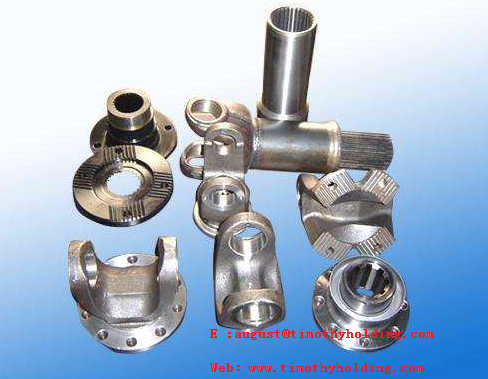
A typical universal joint is composed of a cross shaft, cross bearings, and a flange yoke. It is a key component of the vehicle's drive shaft. In front-engine, rear-wheel-drive vehicles, the universal joint drive shaft is installed between the transmission output shaft and the drive axle final drive input shaft. In front-engine, front-wheel-drive vehicles, the drive shaft is omitted, and universal joints are installed between the front axle half-shafts (which are responsible for both driving and steering) and the wheels. During vehicle operation, uneven road surfaces cause jolting, load changes, or differences in the installation positions of the two assemblies—all of which can alter the angle and distance between the transmission output shaft and the drive axle final drive input shaft. Therefore, a device that "adapts to changes" is needed to solve this problem, leading to the development of the universal joint.


2. Transmission Characteristics:

In front-engine, rear-wheel-drive (or all-wheel-drive) vehicles, suspension deformation during movement causes frequent relative motion between the drive axle final drive input shaft and the transmission (or transfer case) output shaft. Additionally, to avoid certain mechanisms or devices (making linear power transmission impossible), a device is necessary to ensure normal power transmission—hence the emergence of universal joint transmission. Universal joint transmission must meet the following characteristics:

  • a. Reliably transmit power when the relative position of the two connected shafts changes within the expected range;

  • b. Ensure uniform operation of the two connected shafts. The additional load, vibration, and noise caused by the universal joint angle must be within allowable limits;

  • c. High transmission efficiency, long service life, simple structure, easy manufacturing, and convenient maintenance. For vehicles, since the output shaft of a single cross-shaft universal joint rotates at a non-uniform speed relative to the input shaft (when there is a certain angle), a double universal joint (or multi-universal joint) transmission must be used. The two universal joint yokes connected to the same drive shaft should be arranged in the same plane, and the angles of the two universal joints should be equal. This is extremely important. During design, the angle of the universal joint should be minimized as much as possible.

  • Telescopic Sleeve

In the traditional drive shaft structure, the spline sleeve is welded to the flange yoke, and the spline shaft is welded to the drive shaft tube. The new-type drive shaft abandons this traditional structure: instead, the spline sleeve is welded integrally with the drive shaft tube, and the spline shaft is made integrally with the flange yoke. Furthermore, the rectangular-tooth spline is replaced with a large-pressure-angle involute short-tooth spline, which not only enhances strength but also facilitates extrusion forming, meeting the requirements of high-torque working conditions. The tooth surfaces of the telescopic sleeve and spline shaft are fully coated with a layer of nylon material, which not only improves wear resistance and self-lubrication but also reduces damage to the drive shaft caused by impact loads and enhances buffering capacity.

This type of drive shaft adds a tubular sealing protective sleeve outside the flange spline shaft. Two polyurethane rubber oil seals are installed at the end of this protective sleeve, creating a fully sealed space inside the telescopic sleeve. This prevents the telescopic spline shaft from being eroded by external sand and dust, providing both dustproof and rustproof protection. Therefore, during assembly, applying lubricating grease once between the spline shaft and the sleeve fully meets the service requirements. There is no need to install an oil nipple for lubrication, reducing maintenance tasks.


Shaft Bushing

Shaft bushings are designed to reduce friction and wear when the shaft moves. Their basic purpose is similar to that of bearings, and they are relatively cheaper. However, they have higher frictional resistance, so they are only used in some components. Most shaft bushings are made of copper, but plastic ones are also available. Shaft bushings are mostly placed between the shaft and the supporting structure, fitting tightly to the supporting structure—only the shaft can rotate on the bushing. When assembling the shaft and shaft bushing, lubricant is added between them to reduce friction during rotation.

Heavy-duty Vehicle Drive Shaft,www.timothyholding.com


Contact Name:August

Mobile Phone:+86-13758897904

E :august@timothyholding.com

Web:www.timothyholding.com

Address:55# Jinshi Road ,Lecheng Industrial Park,Yueqing City,Zhejiang provice,China
Sunday, January 18, 2026

Universal Joint Couplings as Critical Mechanical Transmission Components


Universal Joint Couplings as Critical Mechanical Transmission Components

文章附图

Universal Joint Couplings as Critical Mechanical Transmission Components

Fundamental Role in Power Transmission

Universal joint couplings serve asessential components in mechanical power transmission systems, widely employedin:

  • Automotive     systems

  • Lifting     and transportation equipment

  • Construction     machinery

  • Industrial     machinery

    Universal joint couplings.png

Common Types of Constant Velocity Joints

  1. Rzeppa (Ball-type) Joints

  2. Double Cardan Joints

  3. Cross-slider Couplings

  4. Disc-type Couplings

These are particularly suitable forconnecting:

  • Intersecting     shafts

  • Parallel     shafts

  • Providing     constant velocity transmission

Advanced Spatial Mechanism Applications

Recent research has developed specializeduniversal joint designs for:

  • Direct     connection of spatial intersecting shafts

  • Large-angle     intersecting shaft connections (with wide variable range)

  • Simplified     manufacturing with fewer components

Critical Application Case: Tube RollingMills

In rolling mill main drive systemsconsisting of:

  • Main     motor

  • Reducer

  • Connecting     shaft

  • Universal     joint coupling

The universal joint coupling represents themost vulnerable mechanical component, where traditional design approaches facedlimitations:

Traditional Design Limitations

  1. Engineering Mechanics     Methods

    • Limited accuracy

    • Poor reliability

  2. Empirical Formula Methods

    • Based on experimental data

    • Required large safety factors

    • Resulted in oversizing and higher costs

Modern Computational Analysis Advancements

With computer technology development,numerical analysis methods have revolutionized design:

Finite Element Method (FEM) Advantages

  • Powerful     computational mathematics approach

  • Widely     adopted in metallurgical equipment design

  • Particularly     effective for complex components like universal joints

  • Provides     practical, reliable and convenient analysis

Modeling Optimization Techniques

Key simplifications in FEM modeling:

  1. Focus on Critical     Components

    • Primarily analyzing the yoke head

    • Simplified modeling of roll-end components

  2. Contact Simulation

    • Independent modeling of:

      • Yoke

      • Jaw

      • Roll-end flange

    • Creation of contact pairs to simulate force transmission

  3. Reasonable Simplifications

    • Ignoring non-load-bearing bolts

    • Omitting minor fillets and rounds

    • Eliminating rigid body displacement

Performance Enhancement Strategies

  1. Precision Manufacturing

    • Improved component geometry

    • Enhanced surface finishes

  2. Material Optimization

    • Advanced alloy selection

    • Heat treatment processes

  3. Maintenance Considerations

    • Lubrication system design

    • Wear monitoring techniques


  4. Timothy Holding Co.,Ltd.

    Sales Manager

    Mobile+86-13758897904(August.Zeng)

    Sales Email: august@timothyholding.com

                       timothyholding@163.com


    http://www.timothyholding.com


    Add:55# Jinshi Road,Lecheng   Industrial Part,Yueqing City,Zhejiang Province,China

https://www.timothyholding.com/Universal-Joint-Couplings-Transmission-Components.html

Wednesday, December 3, 2025

SWP-B Universal Joint Shaft Coupling


SWP-B Universal Joint Shaft Coupling


文章附图

SWP-B Universal Joint Shaft Coupling


The SWP-B universal joint shaft coupling is a cross-shaft type universal joint coupling featuring a telescopic (lengadjustable) design. It is widely used in various types of heavy machinery.


The SWP-B universal joint shaft is mainly composed of two universal joint yokes, a cross shaft, bearing housings, and other components. It boasts a compact structure and high transmission efficiency, enabling it to connect two transmission shaft systems with different axes, thereby achieving angle compensation and axis offset adjustment. Meanwhile, this coupling is also equipped with a telescopic function, allowing it to adapt to axial displacements within a certain range.


The SWP-B coupling is suitable for rolling machinery, lifting and transportation machinery, and other heavy machinery that requires connecting two transmission shaft systems with different axes.

When installing the SWP-B cross-shaft universal joint coupling, it is necessary to ensure the cleanliness of the flange joint surface and avoid impurities such as anti-rust grease. At the same time, the flange connection bolts must be tightened according to the specified tightening torque to ensure the stability and reliability of the coupling.

During the operation of the SWP-B cross-shaft universal joint coupling, long-term overloading should be avoided to prevent operational accidents.


During working operation, it is essential to frequently check the universal joint coupling for abnormal radial runout, bearing overheating, and other phenomena. Once such phenomena are detected, the machine should be shut down promptly for inspection and maintenance.


The SWP-B cross-shaft type universal joint coupling is a heavy machinery transmission component with a compact structure, high transmission efficiency, and a wide range of applications. During installation and maintenance, operations must be carried out strictly in accordance with regulations to ensure its normal operation and extend its service life.

Key Terminology Explanation (for clarity in engineering context)

swp universal joint shaft coupling.png

  • Universal joint coupling: A mechanical component used to transmit torque between two shafts that are not collinear (have misaligned axes).


  • Cross-shaft type: A common design of universal joint where a cross-shaped shaft (cross shaft) connects two yokes, enabling angular movement.


  • Telescopic function: The ability of the coupling to adjust its length, accommodating axial (along the shaft) displacements between connected shafts.


  • Tightening torque: The specific rotational force required to fasten bolts, ensuring secure assembly without damaging components (critical for mechanical stability).


Contact Name:August

Mobile Phone:+86-13758897904

E :august@timothyholding.com

Web:www.timothyholding.com

Address:55# Jinshi Road ,Lecheng Industrial Park,Yueqing City,Zhejiang provice,China

Tuesday, November 25, 2025

SWC225/250/285/315-BF Type Cardan Shaft


SWC225/250/285/315-BF Type Cardan Shaft

SWC225/250/285/315/350/390/440/550/620-BF Flange Type Cardan   Shafts


SWC225/250/285/315/350/390/440/550/620-BF Flange Type Cardan   Shafts

Product Features:

  1. Compact and reasonable structure. The SWC type adopts an integral yoke, making operation more reliable.

  2. Strong angular compensation capability. The axis deflection angle of the SWC type can reach 15-25 degrees.

  3. Stable operation, low noise, simple assembly, disassembly and maintenance, high transmission efficiency. It is suitable for high-power transmission, featuring energy saving, strong load-bearing capacity and high torque.

Product Material:

  • Regular material: 35CrMo and 20CrMnTi

  • Special customization available according to requirements

Cardan shaft is widely used in rolling mill, punch, straightener, crusher, ship drive, paper making equipment, common machinery, water pump equipment, test bench, and other mechanical applications.

Advantage:
1. Low life-cycle costs and long service life;
2. Increase productivity;
3. Professional and innovative solutions;
4. Reduce carbon dioxide emissions, and environmental protection;
5. High torque capacity even at large deflection angles;
6. Easy to move and run smoothly;

SWC225/250/285/315/350/390/440/550/620-BF Flange Type Cardan   Shafts


Contact Name:August

Mobile Phone:+86-13758897904

E :august@timothyholding.com

Web:www.timothyholding.com

Address:55# Jinshi Road ,Lecheng Industrial Park,Yueqing City,Zhejiang Province,China